


What Temperature Should a Freezer Be? Ideal Setting, Safety Tips and Checking Guide

Most of us set the freezer once and never think about it again. The dial sits on a number, the food stays hard, and everything seems fine. But is it actually cold enough? A freezer that runs even a few degrees too warm can quietly damage your food, shorten its storage life, and waste money through freezer burn and spoilage.
So, what temperature should a freezer be? In this complete guide, you will learn the recommended setting, why it matters, how to check your real freezer temperature, how to adjust it, and how to keep it stable. You will also find storage time guidelines, power outage advice, a troubleshooting table and answers to the most common questions.
Table of Contents
- The Ideal Freezer Temperature
- Why 0°F (-18°C) Is the Magic Number
- Freezer vs Refrigerator vs Danger Zone
- Does the Type of Freezer Matter?
- How to Check Your Freezer Temperature
- How to Adjust the Temperature
- What Happens If the Freezer Is Too Warm or Too Cold
- How Long Can Food Stay in the Freezer?
- What to Do During a Power Outage
- Tips to Keep Your Freezer Stable and Efficient
- Troubleshooting Common Problems
- Choosing a Freezer Thermometer and a New Freezer
- Frequently Asked Questions
- Final Thoughts
The Ideal Freezer Temperature
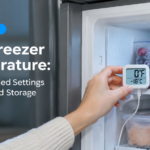
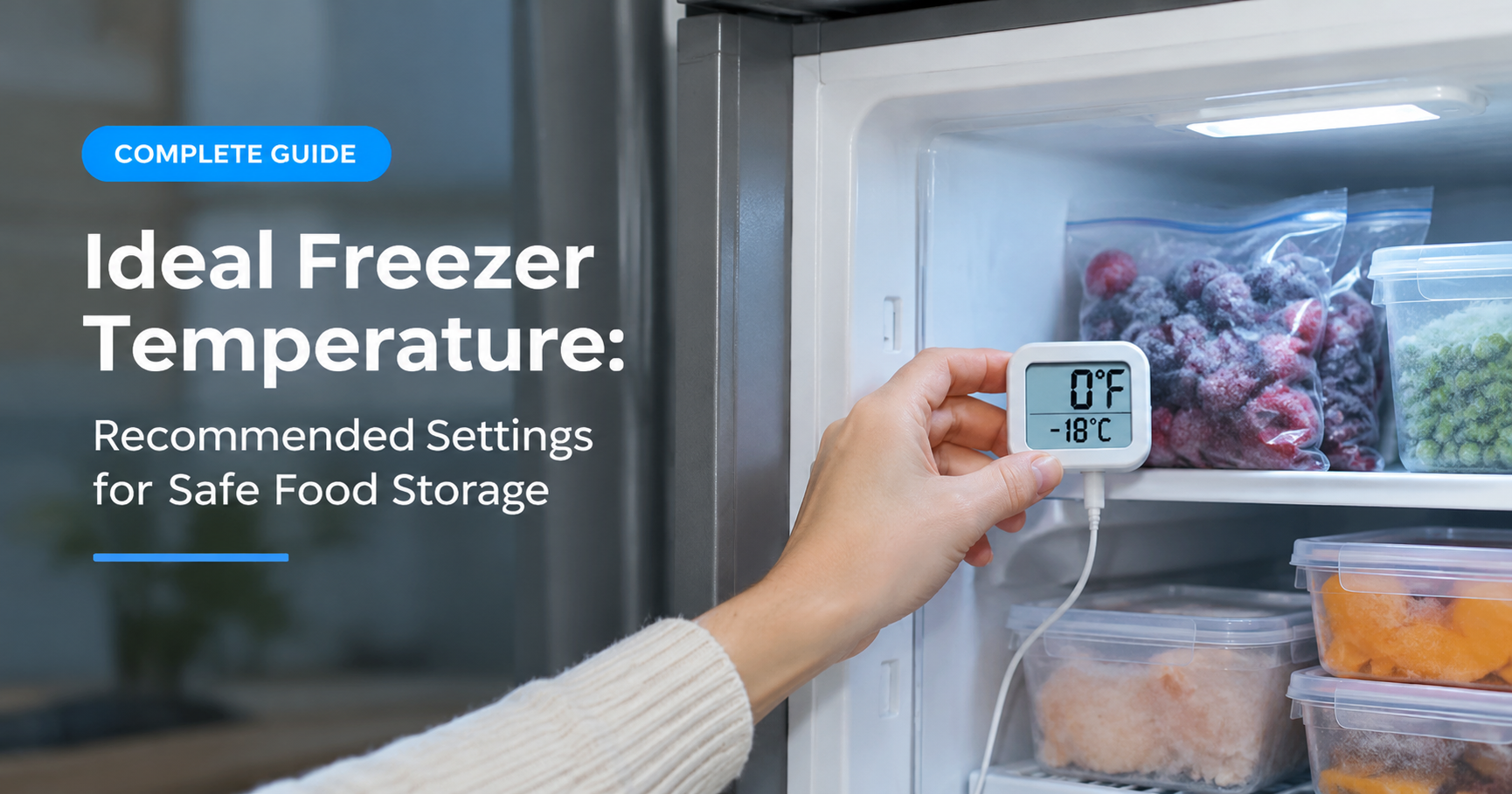
The recommended freezer temperature is 0°F (-18°C). If your freezer sits at this level or a little colder, you are in the right place. Most home freezers are designed to operate comfortably at this target, and most manuals recommend it.
You may see other numbers mentioned. Some people like -5°F (-20°C) for extra margin, and some energy-saving guides suggest slightly warmer settings. For everyday home use, aiming for 0°F (-18°C) is the safest and most widely accepted choice.

Why 0°F (-18°C) Is the Magic Number
There are three good reasons this temperature is recommended.
- Bacteria stop growing. Microorganisms such as bacteria, yeasts and molds become inactive at 0°F. Freezing does not kill all of them, but it keeps them from multiplying. When food thaws, they can become active again, which is why safe thawing matters.
- Enzyme activity slows right down. Natural enzymes in food continue to change flavor, color and texture even while frozen. The colder the food, the slower this process happens.
- Quality lasts longer. At 0°F, ice crystals stay small and stable. Warmer or fluctuating temperatures create larger crystals that damage texture and cause freezer burn.
According to food safety guidance, food kept constantly frozen at 0°F stays safe to eat indefinitely. The time limits you see on charts are about quality, not safety.
Freezer vs Refrigerator vs Danger Zone
It helps to see freezer temperature alongside other important numbers in your kitchen.

The refrigerator should be at or below 40°F (4°C). The range between roughly 40°F and 140°F (4°C to 60°C) is known as the danger zone, where bacteria can multiply rapidly. Food should not stay in this range for more than two hours, or one hour if the surrounding temperature is above 90°F (32°C).
Does the Type of Freezer Matter?
The target temperature is the same for every type of freezer, but each style has its own quirks.
| Freezer Type | Target Temperature | Good to Know |
|---|---|---|
| Top or bottom freezer in a fridge | 0°F (-18°C) | The door is opened often, so temperatures can swing more. |
| Side-by-side freezer section | 0°F (-18°C) | Check the temperature on more than one shelf. |
| Upright freezer | 0°F (-18°C) | Easy to organize, but loses more cold air when opened. |
| Chest freezer | 0°F (-18°C) | Holds cold better because cold air sinks and stays inside. |
| Garage or outbuilding freezer | 0°F (-18°C) | Check the manual for its supported room temperature range. |
If you keep a freezer in a garage, shed or other unheated space, remember that extreme heat or cold in the room can affect how well it works. Some models are built for a wider ambient range than standard indoor units.
How to Check Your Freezer Temperature
Do not trust the dial alone. Many freezers show a number from 1 to 7 or a vague “cold to colder” scale, and even digital displays often show the set point rather than the real temperature inside. The reliable method is to measure it yourself with an appliance thermometer.

Step-by-Step Method
- Get a thermometer made for freezers. A regular kitchen or meat thermometer is not designed for continuous cold use.
- Place it in the middle of the freezer, away from walls, the door and the cooling vents, ideally between packages.
- Close the door and wait about 24 hours so the reading can settle.
- Read the temperature quickly. Keep the door open for as short a time as possible.
- Adjust if needed. If the reading is above 0°F, lower the setting by one notch and test again after another day.
Test again after any major change, such as a new season, a move, a repair, or adding a lot of unfrozen food.
How to Adjust the Temperature
Every brand uses a different control style, so always check the manual. These are the most common ones.
- Numbered dial: Higher numbers usually mean colder, but this varies. Change one step at a time.
- Digital controls: Press the temperature or freezer button and choose a set point such as 0°F or -18°C.
- Shared fridge-freezer control: On some older models, one dial controls both sections. Changing the freezer can change the fridge, so check both afterward.
- Chest freezer thermostat: Usually a simple knob with a range from warmer to colder. Test after each change.
Always wait at least 24 hours after an adjustment before changing it again. The freezer needs time to reach its new level.
What Happens If the Freezer Is Too Warm or Too Cold
Too Warm (Above 0°F)
- Faster freezer burn, dry spots and off flavors
- Larger ice crystals that spoil texture
- Shorter quality life for stored food
- Partly soft food, which can mean it has thawed and refrozen
- If the freezer is much warmer, food can start to thaw and become unsafe
Too Cold (Far Below 0°F)
- Higher electricity use for very little added benefit
- Extra wear on the compressor
- Possible freezing of items stored nearby, if the freezer shares airflow with the fridge
Slightly colder than 0°F is not a problem for food. It simply costs more to run. Aim for a steady reading right around the target.
How Long Can Food Stay in the Freezer?
Food kept at a constant 0°F stays safe indefinitely, but flavor and texture decline with time. Use these approximate guidelines for best quality.

| Food | Approximate Best-Quality Time at 0°F |
|---|---|
| Bacon | About 1 month |
| Bread and baked goods | 2 to 3 months |
| Ground meat | 3 to 4 months |
| Cooked leftovers and casseroles | 2 to 6 months |
| Fruits and vegetables | 8 to 12 months |
| Steaks, chops and roasts | 4 to 12 months |
| Whole chicken or turkey | Up to 12 months |
Tip: Label every package with the date and contents. A permanent marker and freezer-safe bags or containers make rotation much easier.
What to Do During a Power Outage
A power cut is where a properly set freezer proves its value. A freezer that is well stocked and kept at 0°F holds its cold far longer than a refrigerator does.

- Keep the door closed. Every opening lets cold air out.
- Group food together. A full freezer stays cold longer because the frozen items insulate each other.
- Use an appliance thermometer. When power returns, check the temperature. Food with ice crystals or at 40°F or below can usually be refrozen or used, though quality may drop.
- When in doubt, throw it out. If food has been above 40°F for more than two hours, do not take the risk.
Tips to Keep Your Freezer Stable and Efficient
- Keep it fairly full. A well-stocked freezer holds temperature better. If you have empty space, fill it with containers of water or ice packs.
- Do not overpack the vents. Air must circulate for even cooling.
- Cool hot food first. Let cooked food cool briefly, then freeze it in shallow containers.
- Open the door less often. Decide what you need before you open it.
- Check the door seal. Close the door on a strip of paper. If it pulls out easily, the gasket may need cleaning or replacing.
- Defrost manual-defrost units. When frost builds up to about 1/4 inch (6 mm), it is time to defrost.
- Clean the coils. Dust on the condenser coils makes the freezer work harder.
- Leave breathing space. Allow a few inches of gap around the freezer for ventilation.
- Use airtight packaging. Wrap food well to reduce freezer burn.
Troubleshooting Common Problems
| Problem | Possible Cause | What to Try |
|---|---|---|
| Freezer not cold enough | Setting too warm, blocked vents, dirty coils | Lower the setting by one step, clear vents, clean coils. |
| Too much frost | Door left open, worn seal, humid room | Check the seal, close the door fully, defrost if manual. |
| Freezer burn on food | Poor packaging or temperature swings | Use airtight packaging and keep the temperature steady. |
| Ice cream too soft | Temperature above target or near the door | Verify with a thermometer and store it deeper inside. |
| Food at the back frozen hard, front soft | Uneven airflow | Rearrange items so air can circulate. |
| Freezer runs constantly | Dirty coils, overload, high room temperature | Clean coils, reduce load, improve ventilation, call a technician if it continues. |
If the freezer will not hold temperature even after these checks, it may have a failing thermostat, a refrigerant problem or a worn compressor. Call a qualified technician before the food is at risk.
Choosing a Freezer Thermometer and a New Freezer
Types of Freezer Thermometers
- Dial (analog) appliance thermometer: Simple, inexpensive and battery-free. Look for a clear scale that includes 0°F.
- Digital thermometer with an external display: Lets you check the temperature without opening the door.
- Thermometer with min/max memory: Shows the warmest and coldest readings, which helps you spot overnight swings or power problems.
- Wireless or app-connected monitor with alerts: Sends a notification if the temperature rises, handy for large chest freezers in a garage or basement.
- Door alarm: Warns you if the door is left ajar.
What to Look for When Buying a Freezer
- Capacity: Think about household size and shopping habits. A rough guide is about 1.5 cubic feet per adult, plus extra if you buy in bulk.
- Type: Chest freezers are efficient and hold cold well. Upright freezers are easier to organize.
- Frost-free or manual defrost: Frost-free is convenient, while manual defrost can be more efficient and better at preventing freezer burn.
- Energy efficiency: Check the energy rating. An efficient model pays back over its life.
- Temperature display and alarm: Models with a digital readout and high-temperature alert add real peace of mind.
- Ambient temperature rating: Essential if the freezer will live in a garage or outbuilding.
- Lock and power-on indicator: Useful for safety and to avoid accidental unplugging.
Frequently Asked Questions
What is the best temperature for a home freezer?
The best setting is 0°F (-18°C) or below. This keeps food frozen solid and protects quality.
Is -18°C the same as 0°F?
Practically, yes. -18°C is about -0.4°F, so the two figures are used interchangeably for freezer temperature.
Is 5°F too warm for a freezer?
It is above the recommended level. Food may stay frozen, but quality can decline faster. Lower the setting a little and check again.
Is -10°F too cold for a freezer?
It will not harm food, but it uses more electricity than needed. Many households do not need to go that low.
What temperature should an ice cream freezer be?
Ice cream is best kept at a steady 0°F or slightly colder. Warm spots near the door can make it soft or icy, so store it toward the back.
How do I know if my freezer is cold enough without a thermometer?
Signs include ice cream staying firm, no soft spots in frozen food, and no large ice crystals. These are only rough clues. A thermometer is the only way to be sure.
Can I refreeze food that has thawed?
Food that thawed in the refrigerator and stayed at 40°F or below can usually be refrozen, though quality may suffer. Food that has sat in the danger zone for more than two hours should be thrown out.
Does a full freezer use less energy?
Generally yes. Frozen items help hold the cold, so the compressor does not need to work as hard after the door is opened.
How often should I check the freezer temperature?
Check it monthly, and also after storms, power cuts, repairs, or any time you notice frost, softening or odd smells.
Final Thoughts
So, what temperature should a freezer be? The answer is simple: 0°F (-18°C) or below. Setting it correctly protects your family from foodborne illness, preserves flavor and texture, and helps your groceries last longer.
The key is to verify rather than assume. Place an appliance thermometer inside, check it after 24 hours, and adjust if needed. Keep the freezer reasonably full, avoid leaving the door open, and keep the seal and coils in good shape. A few minutes of attention now can save you a lot of food, and a lot of money, later.
Disclosure: This article is for general information only. Follow your appliance manual and local food safety guidance. [Add your affiliate disclosure here if you earn commissions.]