







You open the fridge door and the light is on, the motor is humming, but the milk is lukewarm and the vegetables feel warm. A refrigerator running but not cooling is stressful, especially when a week of groceries is at risk. The good news is that many causes are simple and cheap to fix, and a few quick checks can often save you a repair bill.
This guide explains how your refrigerator cools, the most common reasons it stops, step-by-step fixes you can try safely, how to read the symptoms, what repairs typically involve and when it is smarter to replace the appliance.
Quick Summary
- The most common culprits are dirty condenser coils, failed fans, a defrost problem or a worn door seal.
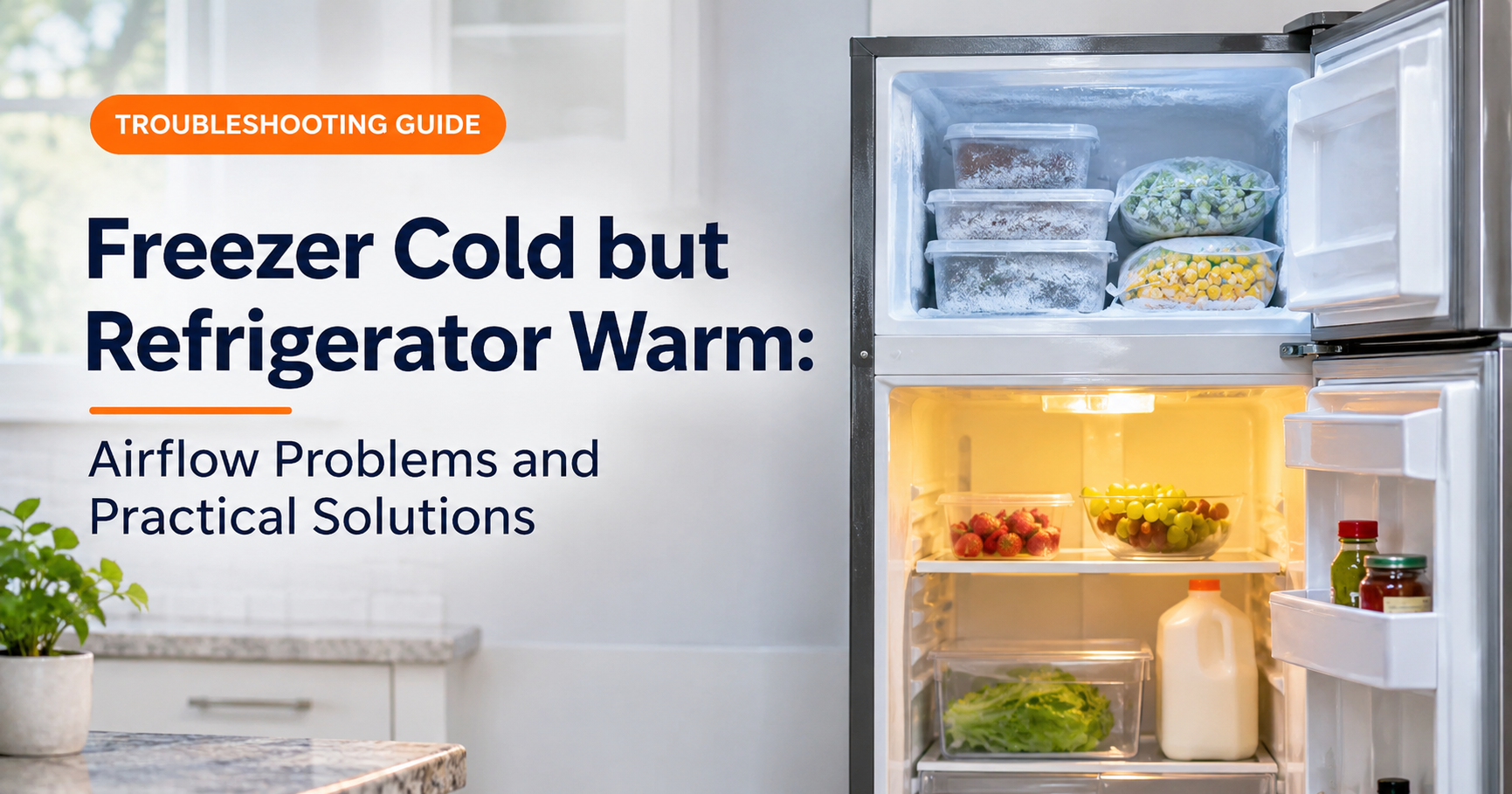
- If the freezer is cold but the fridge is warm, suspect the evaporator fan, air vents or frost buildup.
- If both sections are warm, check the condenser coils, condenser fan, start relay and compressor.
- Always unplug the refrigerator before cleaning or touching any internal part.
- Throw away perishable food that has been above 40°F (4°C) for more than two hours.
First, Protect Your Food
Before you troubleshoot, deal with food safety. A refrigerator should stay at or below 40°F (4°C), ideally around 37°F (3°C), and the freezer at 0°F (-18°C).
- Move perishables such as milk, meat, eggs and leftovers into a cooler with ice packs or ice.
- Keep the freezer door closed. A full freezer stays frozen for roughly 48 hours if unopened, and a half-full one for about 24 hours.
- Discard perishable food that has been above 40°F for more than two hours (one hour if the room is above 90°F).
- Use an inexpensive appliance thermometer to check real temperatures instead of guessing.
- When in doubt, throw it out. Food that smells fine can still carry harmful bacteria.
How Your Refrigerator Actually Cools
A refrigerator does not create cold. It removes heat from the inside and releases it into your kitchen. Understanding the parts makes diagnosis much easier.

The compressor pushes refrigerant through the condenser coils, where heat is released. The refrigerant then flows to the evaporator coils inside the freezer, where it absorbs heat. A fan pulls air over the cold evaporator and sends it through vents into both compartments. The thermostat or control board turns the system on and off, and the defrost system periodically melts frost from the evaporator. If any one of these steps fails, the refrigerator can still run and make noise while the food warms up.
Signs Your Refrigerator Is Not Cooling Properly
- Food spoils faster than normal or milk turns sour early
- The inside feels warm, or the thermometer reads above 40°F
- The freezer is cold but the fridge is warm, or the reverse
- Heavy frost or ice buildup on the freezer back wall
- Condensation or water droplets inside or around the door
- The motor runs constantly or never seems to shut off
- Clicking sounds every few minutes, or a loud buzzing or rattling
- The back or sides of the unit feel unusually hot
Common Causes of a Refrigerator Running but Not Cooling

1. Dirty Condenser Coils
Condenser coils sit at the back or underneath the refrigerator. Over time they collect dust, pet hair and kitchen grease. A thick layer acts like a blanket, preventing heat from escaping. The compressor then runs longer, overheats and still fails to cool properly. This is one of the most common and easiest problems to fix. Manufacturers generally recommend cleaning coils at least once or twice a year, and more often if you have pets.
2. Faulty Condenser Fan Motor
The condenser fan blows air over the coils and compressor. If it stops, heat builds up and cooling drops. Warning signs include a hot compressor area, a fan that does not spin and a refrigerator that runs without ever reaching temperature.
3. Faulty Evaporator Fan Motor
The evaporator fan sits inside the freezer behind a panel and circulates cold air into the fridge section. When it fails, the freezer may remain fairly cold while the fridge compartment warms up. A squealing, chirping or grinding noise from the freezer, or no air coming from the vents, points to this problem.
4. Defrost System Failure
Frost naturally forms on the evaporator coils. A defrost heater, defrost timer or control board, and a defrost thermostat or sensor work together to melt it. When one of these fails, frost builds into a solid block of ice, restricts airflow and the fridge warms. A thick frost layer on the freezer back panel is the classic sign.
5. Worn or Damaged Door Gaskets
The rubber seals around the doors keep warm room air out. Cracked, torn, dirty or loose gaskets let air leak in, causing condensation, frost and constant running. Even a small gap can raise the internal temperature noticeably.
6. Incorrect Settings or Faulty Temperature Control
Sometimes the cause is as simple as a dial bumped to a warmer setting, demo or showroom mode activated, or an energy-saving mode on. In other cases, a failed thermistor (temperature sensor), damper control or thermostat sends wrong signals, so the cooling system never switches on when needed.
7. Defective Start Relay or Overload Protector
The start relay helps the compressor start. If it fails, you may hear a repeated click every few minutes followed by silence, as the overload protector shuts the compressor off. This part is inexpensive, but it involves electrical components, so handle with caution or leave it to a technician.
8. Blocked Air Vents or Overstuffed Shelves
Cold air must flow freely from the freezer into the fridge. Food stacked against the vents, large items blocking airflow or an overloaded fridge can create warm pockets even when everything works correctly.
9. Failing Compressor
The compressor is the heart of the system. When it wears out, it may run weakly, overheat, make loud noises or not start at all. Compressor replacement is expensive and often not worth it on an older refrigerator.
10. Refrigerant Leak
A leak in the sealed system lets refrigerant escape, so the fridge runs but cannot absorb heat. Signs include the compressor running constantly, little or no cooling and sometimes oily residue near the tubing. Fixing a leak requires a licensed technician with proper equipment.
11. Main Control Board or Inverter Board
Modern refrigerators rely on electronic boards to control fans, compressors and defrost cycles. A failed board can cause erratic cooling, a compressor that never starts or random shut-offs. Diagnosis usually needs a technician.
12. Environmental Factors
A refrigerator placed in a very hot garage, close to an oven or in direct sunlight has to work harder. Most units are designed for a room temperature range, and extreme cold can also cause trouble, because some models struggle to cycle properly in unheated spaces.
Diagnose by Symptom
| What You Notice | Likely Cause | What to Try |
|---|---|---|
| Freezer cold, fridge warm | Evaporator fan, blocked vents, frost buildup, damper | Clear vents, listen for fan, defrost manually |
| Both sections warm, compressor humming | Dirty coils, condenser fan, low refrigerant | Clean coils, check fan, call a pro if no change |
| Both warm, no sound at all | Power issue, control board, compressor failure | Check outlet and breaker, then call a technician |
| Clicking every few minutes | Start relay or overload protector | Call a technician or replace the relay carefully |
| Heavy frost on freezer back wall | Defrost heater, timer, sensor or board | Manual defrost, then service the defrost system |
| Water or condensation near doors | Bad gasket or door not closing fully | Clean and test seals, replace if worn |
| Runs nonstop but barely cools | Dirty coils, leaking gasket, refrigerant leak | Clean coils, test seals, then professional check |
Step-by-Step Fixes You Can Try at Home

Step 1: Check Power and Settings
Make sure the refrigerator is plugged in firmly, the outlet works (test it with another device) and the breaker has not tripped. Check that the temperature control is set around 37°F for the fridge and 0°F for the freezer. Confirm that demo mode, vacation mode or an energy-saving mode is not active. Check your user manual if you are unsure.
Step 2: Clean the Condenser Coils
- Unplug the refrigerator.
- Locate the coils at the back (pull the unit out gently) or behind the lower front grille.
- Use a long coil-cleaning brush and a vacuum with a brush attachment to remove dust.
- Clean around the condenser fan and the drip pan area too.
- Plug the refrigerator back in and monitor the temperature over the next 24 hours.
Step 3: Test the Door Seals
Close the door on a dollar bill or a strip of paper. If it slides out easily, the seal is weak. Check several spots around the door. Wipe gaskets with warm, soapy water to remove sticky residue. Slightly warping or tearing means the gasket needs replacing, which is usually a simple, low-cost DIY job.
Step 4: Clear the Air Vents and Do Not Overpack
Rearrange food so nothing blocks the vents inside either compartment. Leave space between items so air can circulate. An overly packed freezer can restrict airflow, and a nearly empty fridge may also struggle to hold temperature, so keep it moderately full.
Step 5: Listen to the Fans
With the doors open, press the door switch to simulate a closed door. You should hear the evaporator fan running in the freezer. Behind the unit, the condenser fan should spin when the compressor runs. If a fan makes unusual noise or does not turn, it likely needs replacing.
Step 6: Manually Defrost the Freezer
- Move all food to a cooler.
- Unplug the refrigerator and leave the doors open.
- Place towels on the floor and a shallow pan under the unit to catch water.
- Let it thaw fully, which may take 24 to 48 hours. Do not chip ice with sharp tools, as you could puncture refrigerant lines.
- Dry the interior, plug it back in and allow several hours to cool down.
If frost returns within a few weeks, the defrost system probably has a failed part.
Step 7: Give the Refrigerator Space and Level It
Allow a couple of inches of clearance at the back and sides for airflow, and keep the unit away from heat sources. A refrigerator that is not level may also cause doors to seal poorly.
Step 8: Reset the Refrigerator
For electronic models, unplug the unit for about five minutes and plug it back in. This can clear a minor control glitch. Give it a full 24 hours to stabilize before deciding whether the issue is fixed.
Safety Tips Before You Start
- Always unplug the appliance before cleaning coils or removing panels.
- Never handle or puncture refrigerant lines. Refrigerant work must be done by a licensed technician.
- Capacitors and electrical parts can hold a charge, so avoid touching them unless you are trained.
- Wear gloves, as coil edges and panels can be sharp.
Helpful Tools and Products to Have
A few inexpensive items make troubleshooting and prevention easier. Many homeowners find these useful:
- Appliance thermometer: For accurate fridge and freezer readings.
- Refrigerator coil cleaning brush: A long, flexible brush that reaches behind and under the unit.
- Replacement door gasket: Choose the correct model-specific part for a tight seal.
- Soft-sided or hard cooler with ice packs: To protect food during repairs or power cuts.
- Refrigerator bins and organizers: They help keep vents clear and improve airflow.
- Surge protector or appliance voltage protector: To safeguard electronics from power spikes.
- Odor absorbers: Useful after spoiled food or a long outage.
When buying replacement parts, always match your refrigerator’s model number, which is usually on a label inside the fridge compartment or on the door frame.
When to Call a Professional

Call a qualified appliance technician if the basic checks do not restore cooling within 24 hours, or if you notice any of these signs: no sound from the compressor, burning smells, oily spots near the tubing, frequent breaker trips, loud grinding or an unusually hot compressor. Replacing sealed-system parts, control boards and compressors should be left to professionals.
Repair Costs: What to Expect
Prices vary widely by brand, model and region, but typical ranges help you plan.
| Repair | Typical Cost (approx.) | DIY Level |
|---|---|---|
| Cleaning condenser coils | Free to low cost with a brush | Easy |
| Door gasket replacement | Low to moderate | Easy |
| Start relay or overload | Low to moderate | Moderate |
| Evaporator or condenser fan motor | Moderate | Moderate |
| Defrost heater, sensor or timer | Moderate | Moderate to hard |
| Main control board | Moderate to high | Hard |
| Refrigerant leak repair and recharge | High | Professional only |
| Compressor replacement | Very high, often close to the price of a new unit | Professional only |
Costs are general estimates and differ by location, parts and labor rates. Ask for a written quote before approving work.
Repair or Replace?
Most refrigerators last about 10 to 20 years. Use these guidelines to decide:
- Repair if the unit is under about 8 to 10 years old and the problem is a simple part such as a fan, relay, sensor or gasket.
- Consider replacing if the repair cost is about half or more of the price of a comparable new model.
- Replace if the compressor or sealed system has failed on an older unit, or if you have needed several repairs in a short time.
- Newer energy-efficient models can lower electricity bills, which adds to long-term savings.
If you are shopping for a new refrigerator, compare size, energy rating, noise level, shelf layout, warranty length and the availability of local service.
How to Prevent Cooling Problems
- Vacuum the condenser coils every 6 to 12 months.
- Wipe door gaskets monthly and check that they seal well.
- Keep the fridge between 35°F and 38°F and the freezer at 0°F.
- Do not overload shelves or block the air vents.
- Allow hot food to cool before putting it in the refrigerator.
- Avoid leaving the door open for long periods.
- Keep the appliance away from ovens, direct sunlight and heat vents.
- Defrost promptly if you see frost building up in a manual-defrost freezer.
- Use a surge protector to guard against voltage spikes.
Frequently Asked Questions
Why is my refrigerator running but not cooling?
The most common reasons are dirty condenser coils, a failed condenser or evaporator fan, a defrost system fault, worn door seals, a bad start relay or a failing compressor. Checking the symptoms in the table above helps you narrow it down.
Why is my freezer cold but my fridge warm?
This usually means cold air is not reaching the fridge section. Common causes are a failed evaporator fan, a frosted-over evaporator, a stuck damper or blocked vents.
How long should I wait after unplugging and restarting?
Allow 24 hours for the refrigerator to reach a stable temperature. If you manually defrosted it, it may take several hours to cool and up to a day to hold the right temperature.
Can a dirty condenser coil really stop a fridge from cooling?
Yes. A heavy layer of dust and pet hair reduces heat release, forcing the compressor to work harder. In many cases, cleaning the coils restores normal cooling.
Is it safe to keep food in a refrigerator that is not cooling?
Only for a short time. If perishable food has been above 40°F (4°C) for more than two hours, discard it. Use a cooler with ice to store food while you fix the problem.
How much does it cost to fix a refrigerator that is not cooling?
Simple fixes like cleaning coils or replacing a gasket cost little, while fan motors, defrost parts and control boards cost more. Compressor and sealed-system repairs can approach the cost of a new refrigerator.
Is it worth repairing a 15-year-old refrigerator?
Often not, especially if the issue is the compressor, a refrigerant leak or a main board. For a minor part, repair can still make sense, but weigh the cost against the price and efficiency of a new unit.
Final Thoughts
A refrigerator that runs but does not cool is frustrating, but it does not always mean you need a new appliance. Start with the easy wins: protect your food, check the settings, clean the condenser coils, test the door seals and clear the vents. If the problem continues, note the symptoms and call a qualified technician before the issue gets worse. With regular maintenance and a few smart habits, your refrigerator can keep your food cold and fresh for many years.
Disclaimer: This article is for general information only. Appliance repairs involve electrical and mechanical risks. Always unplug the appliance before working on it, follow your manufacturer’s manual and consult a licensed technician for complex repairs or refrigerant-related work.