





Standing in a kitchen store (or scrolling an online shop), it’s easy to wonder: blender vs food processor, are they really that different? They look similar, both have a motor, a container and spinning blades, and both promise to save you time. In reality, each one is designed for a very different job.
This guide explains how each appliance works, where each one shines, their pros and cons, and exactly how to decide which one belongs on your counter. By the end, you’ll know whether you need one, the other or both.
Quick Answer: Blender vs Food Processor
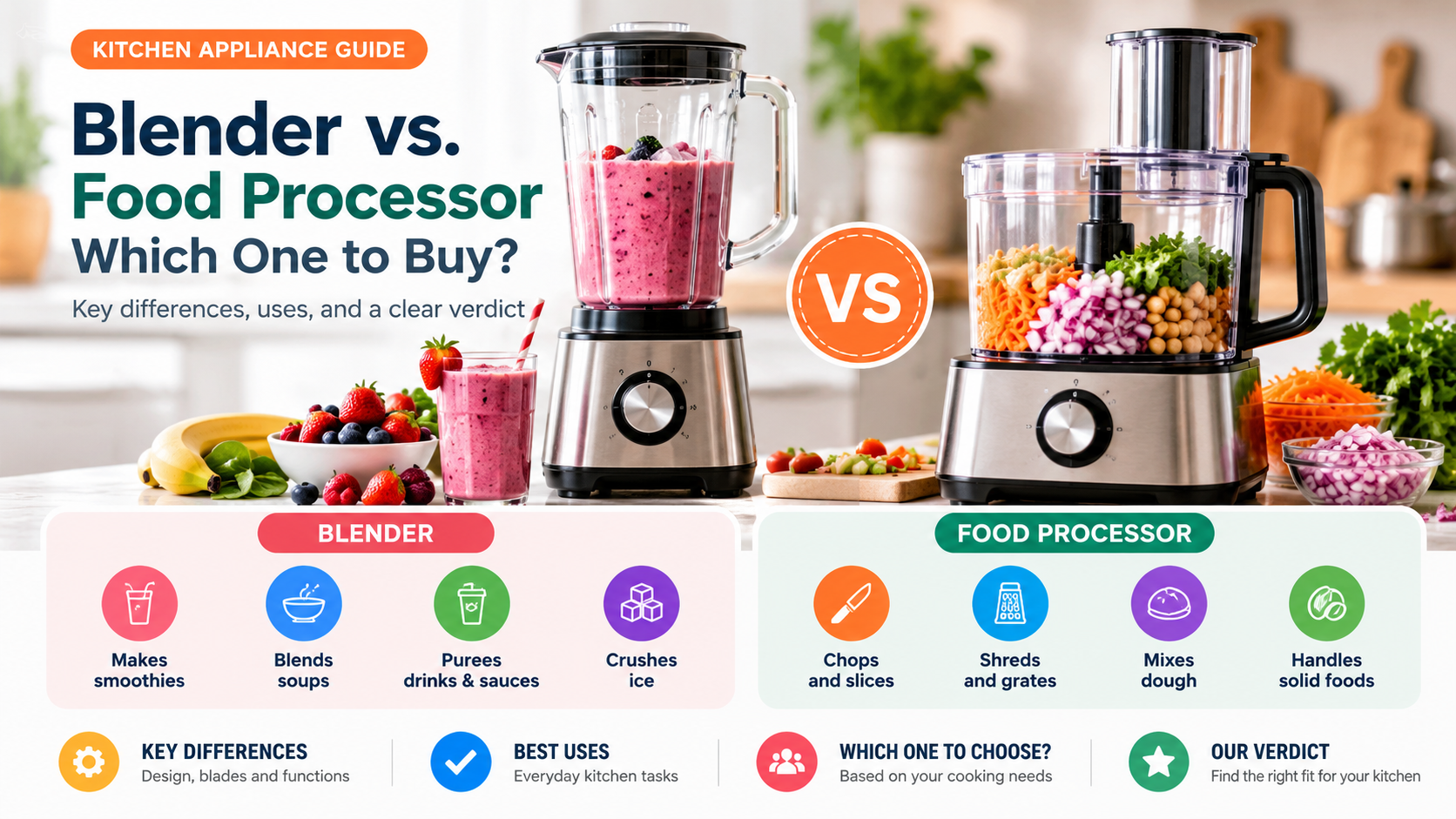
- Choose a blender if you mostly make smoothies, shakes, soups, sauces, crushed ice drinks or anything smooth and liquid.
- Choose a food processor if you mostly chop vegetables, shred cheese, slice, mix dough or make dips with a thicker texture.
- Choose both if you cook often and want the best result for every recipe.
What Is a Blender?
A blender has a tall, narrow jar with a fixed set of blades at the bottom. The blades spin at high speed and pull the contents down into a whirlpool, which is why a blender needs liquid to work properly. The result is a smooth, even mixture.
Blenders are the best choice for smoothies, milkshakes, frozen drinks, creamy soups, sauces and purées. High-powered models can also crush ice, grind nuts and make silky nut butters or plant-based milks.
What Is a Food Processor?
A food processor has a wide, shallow bowl and a flat S-shaped blade. Many models also come with interchangeable discs for slicing and shredding. Because the bowl is wide, solid food spreads out and is cut evenly rather than being pulled into a vortex.
Food processors are ideal for chopping onions, slicing cucumbers, shredding carrots and cheese, mixing pastry or bread dough, grinding meat, and making hummus, pesto and salsa with a little texture.
Key Differences at a Glance
| Feature | Blender | Food Processor |
|---|---|---|
| Container shape | Tall and narrow jar | Wide, shallow bowl |
| Blades | Fixed blades at the bottom | Removable S-blade plus slicing and shredding discs |
| Works best with | Liquids and soft ingredients | Solid and semi-solid foods |
| Typical result | Smooth and silky | Chopped, sliced, shredded or coarse |
| Liquid needed | Yes, usually | Little or none |
| Dough | Not suitable | Good for pastry and many bread doughs |
| Ice crushing | Excellent, especially high-powered models | Possible but not ideal |
| Attachments | Few | Many discs and blades |
Performance by Task
The easiest way to understand the blender vs food processor question is to look at specific jobs. This chart gives a general idea of how typical home models perform.
Smoothies, Shakes and Soups
A blender wins easily. The tall jar and fast blades create a smooth, lump-free texture that a food processor rarely matches. Hot soups can be blended in many models, but always follow the manufacturer’s guidance and never fill the jar to the top.
Chopping and Slicing
A food processor is faster and more even. Chopping an onion takes a few pulses, while a blender tends to turn it into mush. Slicing and shredding discs make quick work of cabbage, carrots and cheese.
Dough and Baking
Food processors can mix pastry, pizza dough and some bread doughs in under a minute. Blenders are not designed for thick dough and the motor can overheat.
Dips, Spreads and Nut Butters
Both can work, but the result differs. A food processor produces thicker, slightly textured hummus, pesto and salsa. A powerful blender makes smoother, creamier versions, though you may need to add extra liquid and scrape the sides.
Pros and Cons
Blender
Pros
- Creates very smooth drinks, soups and sauces.
- Crushes ice and frozen fruit well.
- Usually compact and easy to store.
- Simple to use with few parts.
Cons
- Needs liquid to work properly.
- Poor at slicing, shredding and dough.
- Thick mixtures often stick and need stopping to stir.
Food Processor
Pros
- Very versatile with chopping, slicing, shredding and mixing.
- Handles dry and thick ingredients without added liquid.
- Saves a lot of time with large batches of prep.
- Large capacity bowls suit family cooking.
Cons
- Takes up more counter and cupboard space.
- More parts to wash and store.
- Cannot make truly smooth drinks or crush ice well.
- Thin liquids can leak from some bowls if overfilled.
Can a Blender Replace a Food Processor?
Partly. A strong blender can handle smoothies, sauces, soups, nut milks and some dips. For small amounts of chopping you can use the pulse function carefully, but the results are uneven and you will often need to stop and stir. It cannot slice, shred or knead dough, so it is not a true replacement.
Can a Food Processor Replace a Blender?
Also only partly. A food processor can purée soft ingredients and make thick sauces, but it struggles with thin liquids and never gets the same silky finish. Smoothies will often be gritty or stringy, and ice will be chopped rather than crushed smoothly.
Which One Should You Buy?
- Small kitchen or tight budget: pick the appliance that matches the food you make most often rather than buying both.
- Health-focused household: a blender for smoothies and soups is usually the better first purchase.
- Home cook and meal prepper: a food processor will save the most time.
- Love baking and big batches: choose a food processor with a large bowl.
- Cook a lot: own both. They complement each other rather than compete.
What to Look for When Buying a Blender
- Motor power: higher wattage handles ice and frozen fruit more easily.
- Jar material: glass resists scratches, while BPA-free plastic is lighter and safer to drop.
- Blade quality: stainless steel blades stay sharp longer.
- Capacity: around 1.5 litres suits most families, while single-serve cups suit one or two people.
- Controls: variable speed and a pulse button give you more control.
- Noise level and warranty: check both before you commit.
What to Look for When Buying a Food Processor
- Bowl size: small bowls suit sauces and herbs, while larger ones suit family cooking and dough.
- Included discs and blades: look for slicing, shredding and dough attachments.
- Motor strength: stronger motors cope better with dough and hard vegetables.
- Feed tube size: a wide feed tube reduces pre-cutting.
- Easy cleaning: dishwasher-safe parts save time.
- Storage: check whether the discs store inside the bowl.
Care and Safety Tips
- Always make sure the lid is locked before turning the machine on.
- Don’t overfill; leave room for food to move.
- Let hot liquids cool slightly before blending, and vent the lid as directed.
- Rinse the jar or bowl straight after use to prevent food drying on.
- Handle blades carefully, as they are very sharp.
- Give the motor a rest if you are processing thick mixtures for a long time.
Frequently Asked Questions
Is a blender or food processor better for smoothies?
A blender. It produces a smoother texture and handles ice and frozen fruit far better.
Can I make hummus in a blender?
Yes, but you will probably need to add extra liquid and scrape down the sides often. A food processor makes it easier, and the texture is more traditional.
Can a food processor crush ice?
It can chop ice roughly, but it is not designed for it and results are uneven. Use a blender for ice-based drinks.
Which one is easier to clean?
Blenders usually win because they have fewer parts. Many can even self-clean with warm water and a drop of dish soap.
Do I need both a blender and a food processor?
Not necessarily. If you cook only occasionally, one good appliance that suits your main use is enough. If you cook regularly, having both gives better results and saves time.
Final Thoughts
The blender vs food processor debate comes down to texture and task. If you want smooth, liquid results such as smoothies and soups, a blender is the right tool. If you want to chop, slice, shred or mix dough, a food processor does the job faster and better.
Think about what you cook most often, how much space you have and how much you want to spend. Match the appliance to your habits, and it will earn its place on your counter for years.