




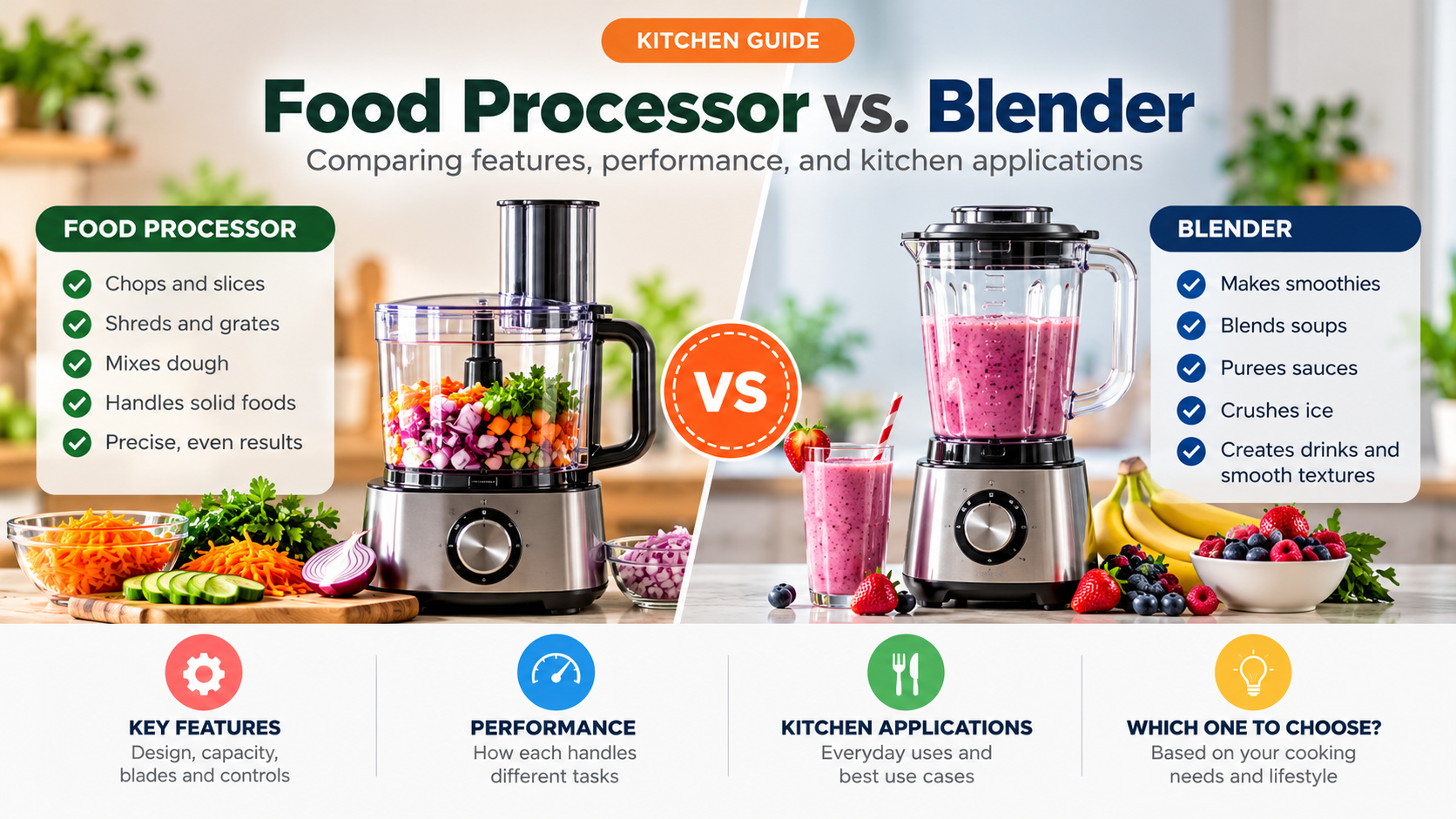
Walk into any kitchen store and you will find a blender and a food processor sitting side by side, often at similar prices and with similar-looking motors. It is no surprise that so many home cooks ask the same question: food processor vs blender, which one do I actually need?
The short answer is that they are built for different jobs. A blender turns liquids and soft ingredients into smooth drinks and sauces. A food processor chops, slices, shreds, and mixes solid ingredients without turning them into liquid. Some tasks overlap, but each appliance has a clear specialty.
Quick Answer
Choose a blender if you mostly make smoothies, soups, milkshakes, and frozen drinks. Choose a food processor if you spend more time chopping vegetables, shredding cheese, making dough, or preparing dips and spreads. If you cook often and do both, owning both is the most practical setup.
What Is a Blender?
A blender is a countertop appliance with a tall jar, usually made of glass, plastic, or stainless steel, sitting on a motorized base. At the bottom of the jar is a set of fixed blades that spin at very high speed. Because the jar is narrow and tall, the spinning blades create a vortex that continuously pulls ingredients down toward the cutting edge.
This design works brilliantly when there is liquid involved. The liquid helps circulate the food, which is why blenders create such smooth results with fruit, leafy greens, ice, yogurt, and milk.
What a Blender Does Best
- Smoothies and protein shakes
- Hot and cold blended soups
- Frozen cocktails and crushed ice drinks
- Pancake and crepe batter
- Smooth sauces, dressings, and purees
- Plant-based milks such as almond or oat milk
What Is a Food Processor?
A food processor has a wide, shallow work bowl and a central spindle that holds interchangeable attachments. The main attachment is the S-shaped blade, which sits near the bottom of the bowl. Most models also include slicing and shredding discs, and many include a dough blade as well.
Unlike a blender, a food processor does not need liquid to work. Ingredients are cut, ground, or mixed in short bursts using the pulse button, giving you control over how fine or coarse the final texture becomes.
What a Food Processor Does Best
- Chopping onions, carrots, herbs, and nuts
- Slicing cucumbers, potatoes, and cabbage
- Shredding cheese and vegetables
- Mixing pie crust and bread dough
- Making hummus, pesto, and thick dips
- Grinding meat or breadcrumbs
Food Processor vs Blender: The Key Differences
On the surface, both machines have a motor, a container, and blades. The differences become clear when you look at how each one is designed and how it handles food.
1. Container Shape
A blender jar is tall and narrow, which keeps liquid circulating around the blades. A food processor bowl is wide and flat, which gives solid ingredients space to spread out and be cut evenly. This single difference explains most of what each machine can and cannot do.
2. Blades and Attachments
Blender blades are usually fixed to the base of the jar and cannot be swapped out. Food processors use removable blades and discs, so one machine can slice, shred, chop, and knead. That flexibility is the main reason many cooks consider a food processor a true prep tool, while a blender is a specialist for liquids.
3. Liquid Requirement
Blenders need liquid to function well. Without enough of it, ingredients stick to the sides of the jar and the blades spin in an air pocket. Food processors work with dry or low-moisture ingredients, and a small amount of liquid is only added when a recipe calls for it, such as when making a sauce.
4. Texture Control
If you want a perfectly smooth result, the blender wins. If you want texture, such as finely chopped salsa, coarse nut crumble, or evenly diced vegetables, the food processor gives you more control through its pulse function.
5. Speed and Power
Blenders run at very high blade speeds to pulverize ingredients. Food processors turn more slowly but deliver strong torque for tougher, denser mixtures such as dough. Motor wattage varies widely across both categories, so it is worth comparing the specifications of the actual model rather than assuming one type is always stronger.
Side-by-Side Comparison Table
| Feature | Blender | Food Processor |
|---|---|---|
| Main purpose | Blending and liquefying | Chopping, slicing, shredding, mixing |
| Container | Tall, narrow jar | Wide, shallow bowl |
| Blades | Fixed at the base | Removable S-blade, discs, dough blade |
| Needs liquid? | Yes, in most cases | No |
| Final texture | Smooth and pourable | Chunky to fine, you control it |
| Dough making | Not suitable | Yes, with the right blade |
| Crushing ice | Excellent in stronger models | Limited |
| Cleaning | Simple, often self-cleaning with soap and water | More parts to wash |
| Storage space | Compact footprint | Bulkier, plus attachments |
Which Tasks Suit Each Appliance?
The easiest way to decide is to think about what you cook every week. The chart below shows how each appliance performs on common jobs. Keep in mind that results depend on the specific model and its motor strength.
Smoothies and Drinks
A blender is the clear choice. Its tall jar and high blade speed break down fruit, greens, and ice into a silky drink. A food processor can leave chunks behind and tends to leak liquid around the bowl when it is filled too high.
Soups
Blenders produce creamy soups with no lumps. Many jars can handle hot liquid when used with a vented lid and filled only partway. A food processor can puree soup in batches, but the wide bowl makes splashing and leaking more likely.
Nut Butters
This is one task where the food processor often has the edge. Its wide bowl lets nuts circulate and gradually release their oils. A powerful blender can make nut butter too, but it may need frequent stopping, scraping, or a tamper tool.
Dips and Spreads
Hummus, pesto, and bean dips are usually easier in a food processor because the mixture is thick and the bowl handles dense ingredients without liquid. A blender can manage these recipes if you add extra liquid, but the texture may turn out thinner than you want.
Chopping, Slicing, and Shredding
Here the food processor has no real competition. A blender will tend to turn vegetables into mush and cannot slice or shred at all. If you prep a lot of fresh produce, a food processor can save a great deal of time.
Dough
Pizza dough, pie crust, and some bread doughs can be mixed in a food processor, especially models that come with a dough blade. Blenders are not designed for dough and can strain the motor.
Pros and Cons
Blender Pros
- Creates the smoothest textures
- Handles ice and frozen fruit well in stronger models
- Easy to use and easy to clean
- Takes up less counter and cabinet space
- Great for hot and cold drinks and soups
Blender Cons
- Needs liquid to work properly
- Cannot slice, shred, or knead dough
- Difficult to blend thick mixtures
- Over-processing can turn food into puree
Food Processor Pros
- Very versatile with interchangeable blades and discs
- Excellent for meal prep and bulk chopping
- Works with dry and thick ingredients
- Pulse control gives you precise textures
- Can handle dough and pastry work
Food Processor Cons
- Cannot make truly smooth drinks
- More parts to clean and store
- Larger footprint on the counter
- Thin liquids can leak from the bowl
Can One Replace the Other?
It depends on what you are willing to compromise on. A strong blender can handle some food processor jobs, such as making sauces, nut butters, and soft dips, but it cannot slice, shred, or knead. A food processor can puree some foods and make rough smoothies, but it will rarely match a blender for smoothness.
If you only have room or budget for one appliance, make your choice based on the type of cooking you do most. Smoothie lovers should pick a blender. People who cook from scratch, prepare large batches, or bake should lean toward a food processor.
Do You Need Both?
If you cook often, having both is not a luxury, it is a time saver. Many households use the blender daily for breakfast drinks and the food processor a few times a week for dinner prep. Some brands also sell combination units or blender sets with food processor attachments. These can be convenient for small kitchens, though a dedicated machine typically performs better at its main task.
What to Look for When Buying a Blender
- Motor power: A stronger motor handles ice, frozen fruit, and fibrous greens more easily. For regular smoothie use, look for a model built to handle frozen ingredients.
- Jar material: Glass resists scratching and staining but is heavier. Plastic is lighter and more shatter-resistant. Stainless steel is durable but you cannot see the contents.
- Jar capacity: Choose a size that fits your household. Larger jars suit families and batch cooking, while smaller cups suit single servings.
- Blade quality: Look for sturdy, well-built blades that can handle regular ice crushing.
- Speed settings: Variable speeds and pulse give you more control than a simple on and off switch.
- Noise level: Powerful blenders can be loud, so check user reviews if noise matters in your home.
- Warranty: A longer warranty is often a sign of confidence in the build quality.
What to Look for When Buying a Food Processor
- Bowl capacity: Smaller bowls suit couples and quick jobs. Larger bowls suit families and bulk meal prep.
- Motor strength: Dough and dense mixtures need a motor with enough power to avoid straining.
- Included attachments: Check for slicing and shredding discs, a dough blade, and any extras you will really use.
- Feed tube size: A wide feed tube lets you fit larger pieces of food without pre-cutting.
- Pulse function: This is essential for controlling texture, especially when chopping.
- Ease of cleaning: Look for dishwasher-safe parts and a design without hard-to-reach corners.
- Stability and safety: A locking lid and non-slip base keep the machine steady during heavy use.
Care and Safety Tips
- Never fill a blender jar beyond the maximum fill line, especially with hot liquids, because steam pressure can push the lid off.
- Let hot soups cool slightly before blending and always keep a vent open or follow the manufacturer’s instructions.
- Unplug both appliances before cleaning or changing blades and discs.
- Handle blades and slicing discs carefully, as they are very sharp.
- Clean right after use so food does not dry and harden on the blades.
- Do not run either machine continuously for longer than the manual recommends, to avoid overheating the motor.
- Check the manual to see which parts are dishwasher safe before putting them in.
Frequently Asked Questions
Is a food processor the same as a blender?
No. They look similar but serve different purposes. A blender is designed for liquids and smooth textures, while a food processor is designed for cutting, shredding, slicing, and mixing solid foods.
Can I make smoothies in a food processor?
You can, but the result is usually less smooth than a blender produces. Pieces of fruit or ice may remain, and thin mixtures can leak from the bowl if you fill it too high.
Can a blender chop vegetables?
It can, but the results are uneven. Blenders tend to turn vegetables into a mush or puree rather than clean, even pieces. If you want chopped vegetables, a food processor is the better tool.
Which is better for making hummus?
A food processor is generally the easier option, because hummus is thick and the wide bowl handles it well. A powerful blender can also make hummus if you add enough liquid and scrape down the sides.
Which is easier to clean?
Blenders are typically quicker to clean because they have fewer parts, and many can be rinsed with warm water and a drop of dish soap. Food processors have extra discs and blades, which take more time to wash.
Which one is better for a small kitchen?
A blender usually takes up less space. If counter space is tight and you want one appliance for most jobs, choose based on your main cooking style, or look for a blender set that includes a small food processor attachment.
Is a food processor worth it if I already have a blender?
If you often chop vegetables, shred cheese, make dough, or prepare dips and spreads, a food processor will save you time and effort. If you mostly drink smoothies and make soups, you may not need one.
Final Verdict: Food Processor vs Blender
The food processor vs blender debate comes down to one simple question: do you want to blend or do you want to prep? If your day starts with smoothies and your dinners include blended soups, a good blender will earn its place on your counter. If you regularly slice vegetables, shred cheese, make dough, or prepare sauces and dips from scratch, a food processor is the better investment.
For serious home cooks, the best answer is often both. Each one takes a different job off your hands, and together they cover almost everything you will need in a modern kitchen. Think about what you cook most, set a realistic budget, and choose the appliance that fits your daily routine.