








Shopping for a new oven or range quickly raises one big question: convection oven vs conventional oven, which one is actually better? Both bake, roast and broil, yet the way they heat your food is different, and that difference changes cooking times, browning, energy use and even the price tag.
In this guide you will learn exactly how each oven works, how their results compare for different types of food, how to convert recipes, and which type fits your cooking style and budget. By the end, you will be able to choose with confidence.
Quick Answer: Which Is Better?
A convection oven is better for most people who roast, bake cookies, or cook multiple trays at once, because a fan circulates hot air for faster, more even cooking and crispier browning. A conventional oven is a solid, usually cheaper choice and works especially well for delicate bakes such as soufflés, custards and some cakes, where moving air can cause problems.
The good news is that many modern ovens offer both modes, so you do not always have to choose one or the other.
Table of Contents
- What Is a Conventional Oven?
- What Is a Convection Oven?
- Key Differences Between Convection and Conventional Ovens
- Cooking Time and Temperature Differences
- Best Foods for Each Oven Type
- Pros and Cons of Each
- Energy Use and Cost
- Types of Convection: Fan vs True (European) Convection
- Tips for Cooking With a Convection Oven
- How to Choose the Right Oven
- Frequently Asked Questions
- Final Verdict
What Is a Conventional Oven?
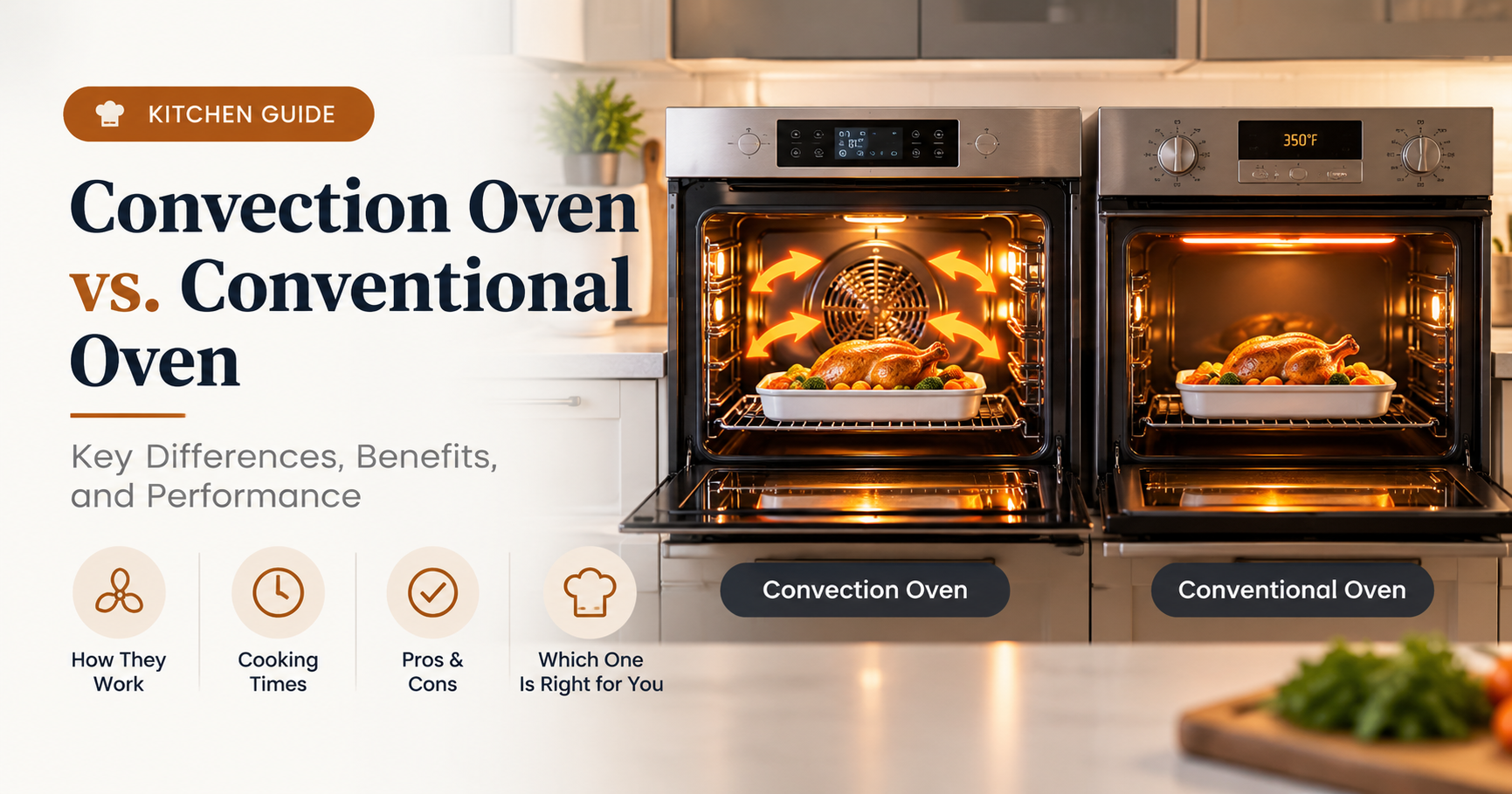
A conventional oven, also called a traditional or standard oven, cooks food using heating elements placed at the top and bottom of the oven cavity. When you set a temperature, the elements heat up and warm the air inside. The heat then spreads naturally through the oven by radiation and gentle natural air movement.
Because there is no fan, the air stays mostly still. This creates slightly different temperature zones inside the oven. Typically, the area near the bottom element is hotter, and the corners or back of the oven can run hotter or cooler than the center. These are commonly called hot spots.
That is why many recipes tell you to rotate the pan halfway through baking. Conventional ovens have been the standard in homes for decades, and most recipes are written with them in mind.
Main Features of a Conventional Oven
- Heating elements at the top and bottom
- No fan, so air is mostly still
- Possible hot and cool spots
- Usually lower purchase price
- Simple controls and easy to use
What Is a Convection Oven?
A convection oven has the same heating elements as a conventional oven, but it adds a fan and an exhaust system. The fan, usually located at the back of the oven, circulates hot air around the food. Moving air removes the cooler layer of air that normally surrounds food, so heat transfers to the surface faster and more evenly.
The result is quicker cooking, more consistent temperatures from rack to rack, and better browning and crisping on the outside of your food.

Main Features of a Convection Oven
- Built-in fan that circulates hot air
- Even heat throughout the oven cavity
- Faster cooking and better browning
- Great for cooking on multiple racks
- Often available as a switchable mode on modern ovens
Key Differences Between Convection and Conventional Ovens
The table below summarizes the most important differences at a glance.
| Feature | Conventional Oven | Convection Oven |
|---|---|---|
| Heat source | Top and bottom elements | Elements plus a fan |
| Air movement | Mostly still | Circulated by a fan |
| Heat distribution | Can have hot and cool spots | More even |
| Cooking speed | Standard | Often around 20 to 25 percent faster |
| Browning and crisping | Moderate | Excellent |
| Multi-rack cooking | Uneven results between racks | Consistent results |
| Delicate bakes | Very good | Can be disturbed by airflow |
| Typical price | Usually lower | Usually higher |

Cooking Time and Temperature Differences
This is where most people get confused. Because a convection oven transfers heat more efficiently, you generally need to adjust standard recipes. Most recipes are written for conventional ovens, so here is how to convert them.
The Simple Conversion Rules
- Lower the temperature by about 25°F (around 15°C), keeping the original cooking time, or
- Shorten the cooking time by roughly 25 percent, keeping the original temperature.
- Start checking early. Check your food about 10 minutes before the recipe says it should be done.
Use one adjustment at a time rather than both together, otherwise the food may overcook or dry out.

Example Conversions
- A recipe calling for 350°F for 60 minutes can be cooked at 325°F for about 60 minutes in a convection oven.
- A 400°F roasted vegetable recipe at 30 minutes can be done in around 22 to 25 minutes in convection mode.
- A whole roast chicken often finishes noticeably sooner and with crispier skin.
Many modern convection ovens have an automatic conversion feature that lowers the temperature for you when you select the convection mode. Check your oven manual to see if yours does this, so you do not accidentally adjust twice.
Best Foods for Each Oven Type
Foods That Cook Best in a Convection Oven
- Roasted meats and poultry: Crispy skin and a well-browned surface while the inside stays juicy.
- Roasted vegetables: Caramelized edges and even cooking without turning soggy.
- Cookies: Several trays can bake at once with consistent color from tray to tray.
- Pastries and pies: Flaky, evenly browned crusts.
- Frozen foods: Fries, nuggets and similar items crisp up much better with moving air.
- Dehydrating and toasting: Nuts, dried fruit and toast cook evenly.
Foods That Cook Best in a Conventional Oven
- Soufflés and delicate cakes: Moving air can cause uneven rising or a lopsided surface.
- Custards, flans and cheesecakes: Gentle, still heat prevents rippling and cracking on the surface.
- Quick breads and batters: A steady environment helps them set properly before a crust forms.
- Foods covered in foil or lids: Casseroles and braises that are covered gain little from airflow.
Pros and Cons of Each Oven Type
Convection Oven Pros
- Cooks food faster, saving time on busy days
- More even heat, so fewer hot spots
- Better browning, roasting and crisping
- Allows reliable multi-rack cooking
- Can use less energy because of shorter cook times
Convection Oven Cons
- Usually costs more upfront
- Recipes need adjusting for time or temperature
- Not ideal for very delicate batters and custards
- The fan can be noisy in some models
- Lightweight foods and foil can be blown around
Conventional Oven Pros
- Lower purchase price
- Works with standard recipes without changes
- Excellent for delicate baked goods
- Simple design with fewer parts that can fail
- Quiet operation
Conventional Oven Cons
- Hot and cool spots can cause uneven results
- Slower cooking and longer preheating
- Pan rotation is often needed
- Multi-rack baking can give inconsistent results
- Less crispy browning on roasted foods
Energy Use and Cost
Because convection ovens cook faster and often at a lower temperature, they can use less energy for many tasks. Shorter cooking times and a faster preheat add up over months of regular use. On the other hand, the fan itself uses a small amount of electricity, so the real savings depend on how often you cook and what you cook.
When it comes to purchase price, convection models typically cost more than comparable conventional models, although the gap has narrowed because convection is now a common feature in mid-range and premium ranges. If you cook several times a week, the upgrade often pays for itself in convenience and quality of results.
Types of Convection: Fan vs True (European) Convection
Not all convection ovens are the same. It helps to know the two main types when comparing models.
- Standard (fan) convection: A fan circulates the heat produced by the usual top and bottom elements. This is the most common type.
- True or European convection: A third heating element is placed around the fan. Air is heated right at the fan before it circulates, which usually gives more even results and works especially well for baking on multiple racks.
True convection models are often priced higher, but they are a good choice if you bake a lot of cookies, pastries or bread and want the most consistent results.
Tips for Cooking With a Convection Oven
- Use low-sided pans. Shallow baking sheets and roasting pans let hot air reach the food from every direction.
- Leave space around pans. Do not crowd the oven. Air needs room to move, so keep a gap between trays and the oven walls.
- Do not cover food unnecessarily. Foil and lids block airflow, which cancels out the benefits of convection.
- Preheat the oven. Even though convection heats quickly, a proper preheat gives more reliable results.
- Use a meat thermometer. Because cook times change, internal temperature is the most reliable way to know when meat is done.
- Rotate trays when baking on several racks. Some models need a swap halfway for perfectly even color.
- Switch to the regular bake mode for delicate recipes. If your oven has both, use the conventional setting for cakes, custards and soufflés.
How to Choose the Right Oven
Ask yourself the following questions before buying.
Choose a Convection Oven If You:
- Roast meat, poultry and vegetables often
- Bake large batches of cookies or cook on multiple racks
- Want crispier results and faster cooking
- Cook for a large family or entertain regularly
- Are happy to adjust recipes slightly
Choose a Conventional Oven If You:
- Are on a tight budget
- Mostly cook simple meals, casseroles or delicate bakes
- Prefer to follow recipes exactly without conversions
- Only use the oven occasionally
What to Look for When Buying
- A switchable convection mode so you can turn the fan off when needed
- Oven capacity that fits your largest baking sheet and roasting pan
- Number of racks and fan positions for multi-tray cooking
- Automatic temperature conversion if you want the oven to adjust recipes for you
- Self-cleaning options and easy-clean interiors
- Reliable warranty and customer support
Frequently Asked Questions
Is a convection oven worth it?
For most home cooks, yes. If you roast, bake several trays at once or want faster, crispier results, a convection oven is a worthwhile upgrade. If you mainly cook simple dishes and delicate bakes, the benefit is smaller.
Can I use a conventional recipe in a convection oven?
Yes. Either reduce the temperature by about 25°F (15°C) or shorten the cooking time by around 25 percent, and check your food a little early.
Do convection ovens cook faster?
Yes. Moving hot air transfers heat to food more efficiently, so cooking is typically faster by about 20 to 25 percent compared with a conventional oven.
Can you bake cakes in a convection oven?
You can, and sturdy cakes often turn out well. For very delicate cakes, soufflés and custards, it is usually safer to use the conventional bake setting or reduce the fan speed if your oven allows it.
Is a convection oven the same as an air fryer?
They use the same basic principle of circulating hot air, but an air fryer is a compact appliance with a powerful fan in a small space, which crisps food very quickly. A convection oven is larger and more versatile for full meals and baking.
Can I use aluminum foil in a convection oven?
Yes, but use it carefully. Foil can block airflow and may be blown around by the fan, so keep it secured and avoid covering food completely unless you want to slow the browning.
Should I use the fan for baking cookies?
Yes. Cookies are one of the best uses for convection because you can bake several trays together and get even browning from tray to tray.
What does convection bake mean on an oven?
Convection bake means the oven runs the fan while using the top and bottom elements, so air circulates around the food for faster, more even baking.
Final Verdict: Convection Oven vs Conventional Oven
Both ovens can produce excellent food. The convection oven wins on speed, even heating, browning and multi-rack cooking, making it the better all-around choice for people who cook often and enjoy roasting and baking in batches. The conventional oven wins on price, simplicity and gentleness for delicate bakes, and it remains a dependable choice for everyday cooking.
If you can, pick an oven that offers both modes. That way you get the speed and crisp results of convection when you want them, and the gentle still heat of a traditional oven for cakes and custards. Think about what you cook most, how much you want to spend, and how many dishes you usually prepare at once, and the right choice will become clear.